What is drawdown in trading?
Drawdown is the fall in an account’s value from its highest point to the lowest point that follows, usually shown as a percentage of that high. If an account grows to $12,000 and then slips to $10,800, it is in a 10% drawdown, even though it is still above where it started. Maximum drawdown is the deepest of those falls over a period. Traders use it to judge how rough a strategy is to live with, and every prop firm uses it as a hard limit. NextGen Funding, backed by Errante, fixes that limit on the first day. This guide covers the maths, a worked series and the floors on each evaluation.
Peak, trough and recovery
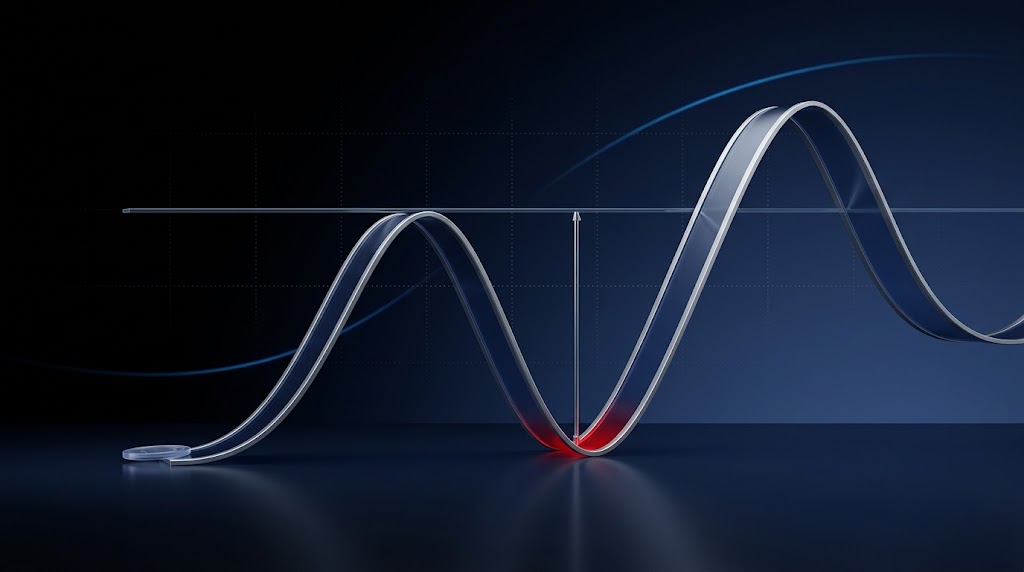
Every drawdown has three parts. First comes the peak, the highest value reached so far. Next is the trough, the lowest value before a new peak appears. Recovery is the climb back above the old peak, which closes the drawdown.
Drawdown says nothing about whether the account is in profit overall. Picture a trader who starts with $10,000, reaches $15,000 and falls to $12,000. That trader has a 20% drawdown and a 20% gain at the same moment.
How to calculate maximum drawdown
Maximum drawdown is the largest peak-to-trough fall, divided by the peak. Here is a series of closing balances for a 10k funded account:
| Point | Balance | Running peak | Fall from peak |
|---|---|---|---|
| Start | $10,000 | $10,000 | 0% |
| A | $10,600 | $10,600 | 0% |
| B | $9,900 | $10,600 | 6.6% |
| C | $11,200 | $11,200 | 0% |
| D | $10,080 | $11,200 | 10.0% |
| E | $11,500 | $11,500 | 0% |
The fall from C to D is $1,120, or 10% of $11,200, which makes it the maximum drawdown for the series. By contrast, the dip at B was smaller in percentage terms, yet it was the only time the balance went below the starting $10,000.
Absolute, maximal and relative drawdown in MT5
The MetaTrader 5 testing report shows three versions of the same idea. Absolute drawdown is the gap between the initial deposit and the lowest balance below it, $100 in our series. Maximal drawdown is the largest fall in money from a local high, $1,120 here. Relative drawdown is the largest fall in percent, 10% here. Each of these appears twice in the report, once for balance and once for equity.
Why recovery takes more than the loss
Losses and gains do not cancel out evenly, because the recovery starts from a smaller base:
| Drawdown | Gain needed to get back to the peak |
|---|---|
| 5% | 5.3% |
| 10% | 11.1% |
| 20% | 25% |
| 30% | 42.9% |
| 50% | 100% |
So a trader who loses half an account has to double what is left to get even. That arithmetic is why most professional risk rules stop the bleeding long before 50%.
Balance drawdown and equity drawdown
Balance counts only closed trades. Equity adds the open profit or loss of trades still running. Imagine a $50,000 account with no closed trades yet and one open position down $1,800. Its balance drawdown is zero, while its equity drawdown is 3.6%.
Many risk limits look at equity, because a trade can be deep in the red long before it is closed. NextGen Funding measures its daily loss limit on equity, which means a running loss counts immediately.
How drawdown limits work at a prop firm
Prop firms turn drawdown into a rule. Fall below the line and the account closes. NextGen Funding draws that line from the opening balance and leaves it there, however much profit comes in. A firm with trailing drawdown prop firm rules moves the line up behind you instead, which leaves less room after a good run. On a $100,000 prop firm challenge, the floors look like this:
| Evaluation | Maximum drawdown | Floor on $100,000 | Daily loss limit |
|---|---|---|---|
| Standard | 10% | $90,000 | 5% |
| Rapid | 8% | $92,000 | 5% |
| Ace | 6% | $94,000 | 3% |
The same limits apply on a simulated funded account after you pass. When the scaling plan raises the balance, the floor is recalculated on the new size, 10% of $125,000 on a scaled $100,000 Standard account, for example.
What drawdown is acceptable?
There is no single right number, but a useful test is how many losing trades in a row your plan can absorb. With 1% risk per trade, eight straight losses cost about 7.7%, inside the 10% limit on Standard and close to the 8% limit on Rapid. Risking 2% per trade, the same run costs about 15% and would break any of the three. Checking your own history in MetaTrader 5 (MT5) for the longest losing streak gives a realistic starting point.
Frequently asked questions
Is drawdown the same as a loss?
Not quite. You measure a loss from where you started, and drawdown from the highest point reached, so an account in profit can still be in drawdown.
What is maximum drawdown in forex?
It is the largest fall from a peak to a trough in a forex account over a chosen period, shown in money or as a percentage of the peak.
Does drawdown include open trades?
Equity drawdown does, balance drawdown does not. Check which one a rule uses before you trade.
What is relative drawdown?
It is the biggest peak-to-trough fall expressed as a percentage, as shown in the MT5 testing report.
Can a drawdown limit be reset at NextGen Funding?
No. Your maximum drawdown floor stays where it was set when the account opened, and it only moves when the scaling plan raises the account size.
Can I withdraw profit while the account is in drawdown?
You can only withdraw profit, so an account trading below its starting balance has nothing to pay out. Once there is profit and the payout window is open, NextGen Funding processes each request within 24 to 48 hours.
How is maximum drawdown calculated on a prop firm account?
It is a fixed percentage of the starting balance at NextGen Funding, so on a $50,000 Standard account the balance may not go below $45,000.
All accounts we provide to our clients are demo accounts with fictitious funds and any trading is in a simulated environment only.