Prop firm South Africa guide to time zones, gold and payouts
Trading from South Africa puts you in SAST, and that one fact changes three things: the local hour the market opens, the moment the daily loss limit resets, and the currency route a payout takes. Ranking lists usually leave all three out, because they depend on where you are and not on the product. This guide works through each with exact figures, so you can judge any prop firm South Africa traders are offered before paying for anything. NextGen Funding, backed by Errante, is the worked example throughout.
How to choose a prop firm from South Africa
Three criteria decide it. First, where the daily loss limit reset falls in your local time. Second, how the metals leverage tiers are set, since gold is the most heavily traded instrument in this market. Third, whether the withdrawal route works with your bank or wallet. Everything else on a prop firm checklist is the same in every country.
Why these three and not the general criteria
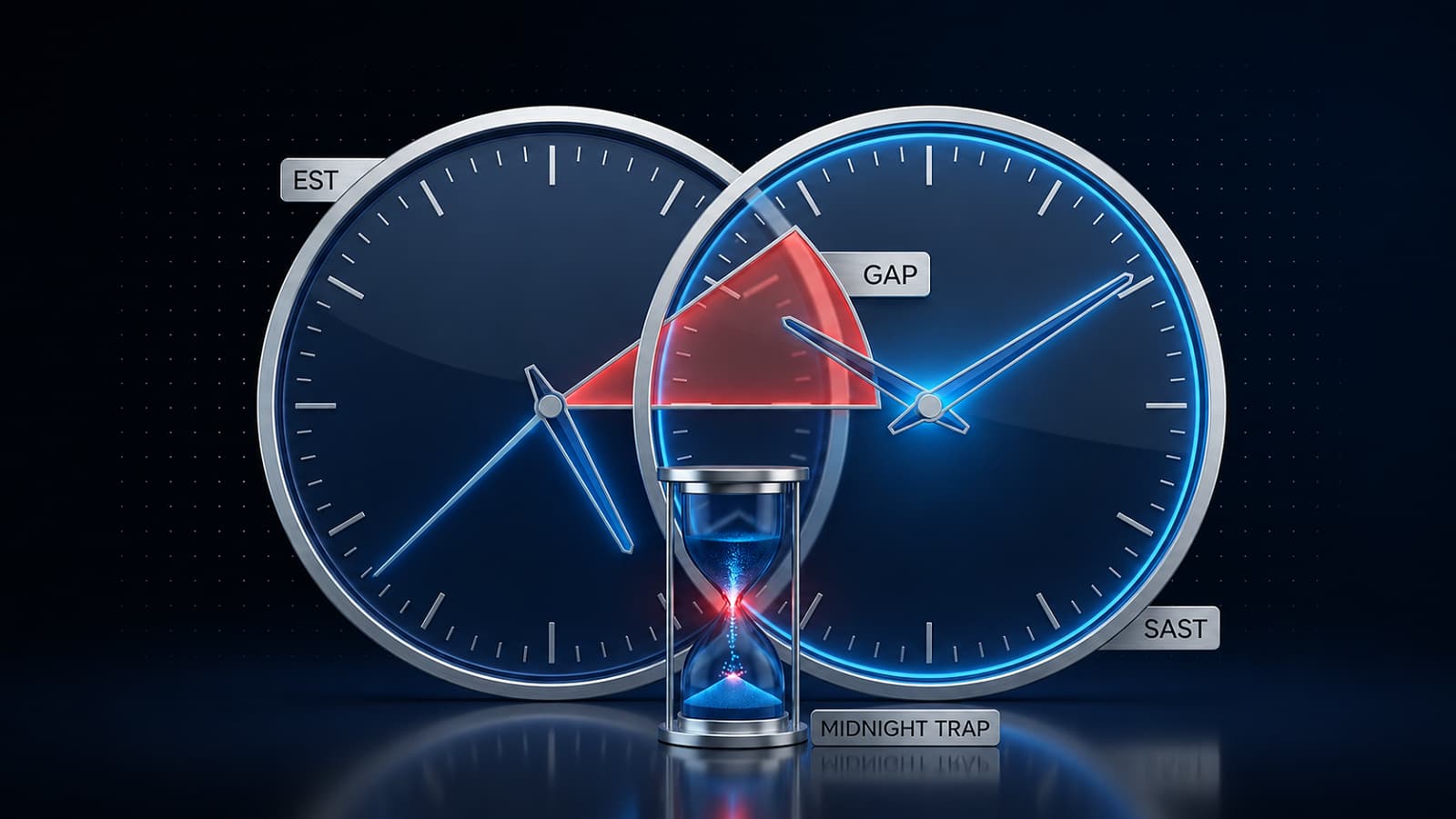
Things like the profit split and whether an evaluation has a deadline are the same for a trader in any country and take one search to find. What the general lists leave out is how your time zone interacts with the risk rules. A rule that fires at five in the afternoon in New York lands near midnight for you, and that gap is exactly where accounts are lost.
Why the South African time zone is an advantage
SAST runs two hours ahead of universal time, which puts the most volatile hours of the market in the middle of your working day.
How SAST overlaps the London session
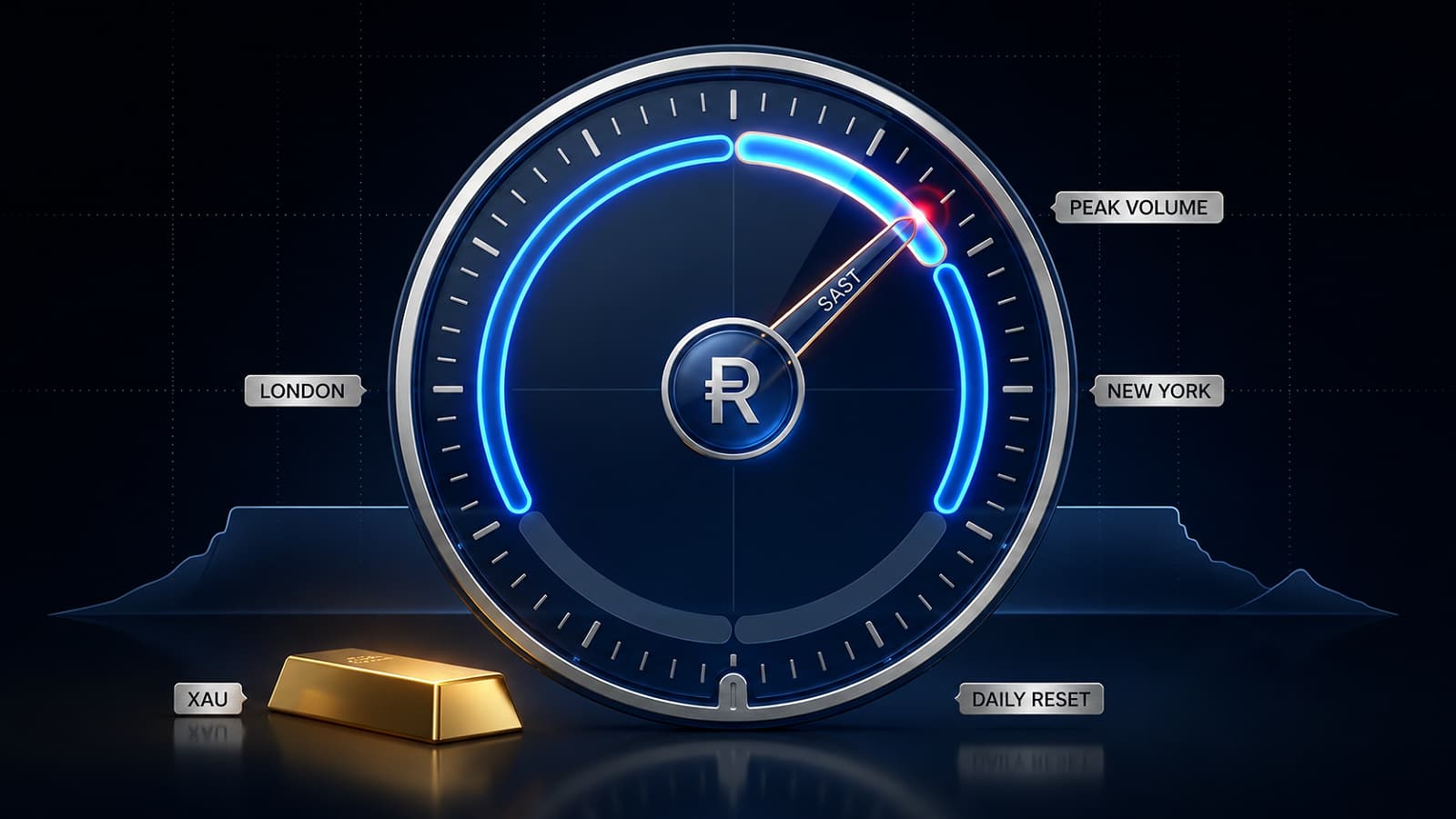
London opens around eight in the morning, London time. With the one or two hour difference, that lands around nine or ten in the morning SAST. New York then opens during your afternoon.
You reach the London and New York overlap without staying up at night. That window brings the highest volume and the widest movement of the trading day. Traders in East Asia stay awake through the night for the same hours.
Your most volatile hours
Mid afternoon into early evening SAST has both major sessions live at once. For a strategy built on breakouts or on volume, concentrating there beats spreading trades across the whole day.
This matters more when a minimum trading day requirement applies. Concentrating on one defined window raises the quality of each trade and keeps the day count regular.
Your daily loss limit reset in local time
This is the most important section of the guide, because more accounts are lost in this time gap than anywhere else.
Converting 5 PM New York into SAST
Your daily loss limit on a simulated funded account resets at 5 PM Eastern time each day, calculated from the previous day’s closing balance. That moment falls close to midnight where you are.
More precisely, the reset lands at 11 PM SAST while the US is on summer time, from March to November, and at midnight SAST for the rest of the year. South Africa does not change its clocks, so twice a year your reset hour moves by an hour without anything changing in your own settings. Traders in Nairobi face the same shift, covered in our guide to prop firms in Kenya.
A common mistake around the reset
Most traders assume the trading day ends at local midnight. From March to November it ends at 11 PM SAST, so a loss taken at 11:30 PM already counts against the new day, the one you expected to start fresh at midnight.
A position still open at the reset also brings its floating loss into the new day, because the new limit is set from the closing balance while the check runs on equity. For example, on a $10,000 Standard account whose balance closed the day at $10,000, the new day’s floor is $9,500. Hold a trade showing a $200 floating loss through the reset, and only $300 of room is left as the new day begins.
Preventing it is simple. Write down both reset times, 11 PM SAST in the US summer and midnight SAST in the US winter, and keep your open volume under control in the hour before the reset.
Gold, metals leverage and the news window
Gold is more familiar to a South African trader than many currency pairs, and the two rules that apply to it are worth reading closely. Our gold funded account guide covers both in more depth.
Metals leverage tiers across the three evaluations
Metals leverage is dynamic and steps down as volume rises. Ceilings are not the same in every evaluation, which means the choice matters before you buy.
- On Standard and Rapid, metals leverage starts at 1:20 and steps down to 1:5 at higher volume.
- On Ace, it starts at 1:10 and steps down to 1:2 at higher volume.
Check this difference before you choose a prop firm challenge. Put the main weight of your strategy on gold and Ace gives you less room. For example, at half a lot the ceiling is 1:20 on Standard and Rapid against 1:10 on Ace, so the same position needs twice the margin on Ace.
Which news restricts gold, and where the rand fits
Dollar news drives gold. The restricted USD releases are the Federal Funds Rate decision, Non-Farm Payrolls (NFP), the Unemployment Rate and wages, GDP q/q, the FOMC Minutes and annual inflation (CPI y/y). Each one triggers the news restriction window on metals as well as on dollar pairs and US indices.
Here is the part that rarely gets stated. The rand is not on the restricted news list. Restricted currencies cover the dollar, euro, pound, Canadian dollar, Australian dollar, New Zealand dollar, franc and yen, plus crude oil. South African economic releases therefore open no restriction window, while dollar releases still restrict gold.
Three evaluations from a South African trader’s view
| Criterion | Standard | Rapid | Ace |
|---|---|---|---|
| Stages | 2 | 2 | 1 |
| Profit target | 10% and 5% | 8% and 5% | 10% |
| Maximum drawdown | 10% | 8% | 6% |
| Daily loss limit | 5% | 5% | 3% |
| Metals leverage ceiling | 1:20 | 1:20 | 1:10 |
| Minimum trading days | 3 | 0 | 3 |
| News trading | Allowed in Phase 1 and Phase 2 | Not allowed | Not allowed |
If your strategy rides dollar news and gold, Standard is the only evaluation that allows that trading, in Phase 1 and Phase 2. Note that news trading is not allowed on any funded account, including one reached through Standard.
Payouts and the payment route
Check two things before you buy: which payment method works for you, and what conditions attach to the first withdrawal.
Available methods and payment currency
Available methods include Visa and Mastercard, bank transfer, and USDT on the TRC20, BEP20 and ERC20 networks.
For a trader in South Africa the digital currency route usually turns out shorter than an international bank transfer, and the timing of any conversion stays in your hands. That list gets updated over time, and you should check the current version in the dashboard before your first withdrawal.
First withdrawal conditions and the fee refund
Withdrawals begin 14 calendar days after your first trade on the funded account, which means the clock starts from that trade and not from purchase. You also need at least $100 in accumulated profit, and you must satisfy the profit distribution rule, which stops any single trading day from making up more than 50% of your total profit. All three conditions have to hold together, and each withdrawal must be at least $50.
From the second withdrawal onward you can withdraw every 7 calendar days, which in normal conditions means three or four withdrawals a month. Each request is processed within 24 to 48 hours of submission. Your evaluation fee comes back with the first withdrawal. Your profit split is up to 90%, and accounts that grow through the scaling plan run at 90%.
Account size and platform
Account sizes run from $5,000 to $200,000, and all trading executes on MetaTrader 5 (MT5). Spreads start from 0.1 pip and vary by instrument. Commission is $3 per lot, charged once, on forex pairs and metals only. For example, 4 lots traded across gold and EUR/USD in a day cost $12 in commission. Gold and the major pairs are what most traders run on a forex funded account, so expect to pay it on most of your trades.
None of the three evaluations runs against a deadline, and no clock presses on your decisions. Two timing conditions remain: a minimum of 3 trading days on Standard and Ace, and at least one 0.01 lot trade in every 90 day period on every account.
Growth over the long term
If you are working on a horizon of years, the scaling plan defines how the account gets larger. In each four-month cycle, a trader who records at least 10% net profit (at least 2.5% per month) and completes at least one withdrawal receives an increase worth 25% of the initial balance.
Growth is stepped, each step the same size, and it never compounds. Take a $50,000 account: one cycle makes it $62,500, the next $75,000, and the path runs to a ceiling of $1 million. Sizes above $200,000 come only this way, and nobody sells them directly. NextGen Funding is backed by Errante, a broker operating under CySEC and the FSA Seychelles. That backing does not make the evaluation business a licensed broker.
Frequently asked questions
Can I trade with a prop firm from South Africa?
Yes. South Africa is one of the markets NextGen Funding serves. You buy an evaluation, pass it and complete identity verification, and once verification clears the simulated funded account is issued within three business days. A separate guide covers the full sequence on how to become a funded trader.
What should a South African trader check first?
Three things: where the daily loss limit reset falls in SAST, how the metals leverage tiers are set since gold is heavily traded here, and whether the withdrawal route works with your bank or wallet.
When does the daily loss limit reset in SAST?
At 5 PM Eastern time, which is 11 PM SAST while the US is on summer time and midnight SAST for the rest of the year. The new limit is calculated from the previous day’s closing balance.
Why does my reset hour change twice a year?
Because the reset is fixed to Eastern time, not to your own. When US clocks shift, the moment slides an hour forward or back in SAST without anything changing in your settings.
Does my trading day end at local midnight?
Only during the US winter, and assuming it always does is a common way to lose an account. From March to November the day resets at 11 PM SAST, so a loss after that counts against the new day, and a position still open at the reset brings its floating loss into it. Write down both reset times and control your open volume in the hour before the reset.
Which market hours suit a SAST trader?
London opens around nine or ten in the morning SAST and New York opens in your afternoon, so the overlap between them falls in your mid afternoon and early evening. That window brings the highest volume of the day.
What leverage do I get on gold?
Metals leverage is dynamic. On Standard and Rapid it starts at 1:20 and steps down to 1:5 at higher volume. On Ace it starts at 1:10 and steps down to 1:2.
Which evaluation is best if I mainly trade gold?
Standard or Rapid, because both allow more room on metals than Ace does. Each is a 2-step challenge, while Ace is a 1-step challenge. If your strategy also depends on trading around dollar releases, Standard is the only one that allows news trading, and only in Phase 1 and Phase 2 of its evaluation.
Does South African economic data create a news restriction?
No. Rand data is not on the restricted list. Restricted currencies are the dollar, euro, pound, Canadian dollar, Australian dollar, New Zealand dollar, franc and yen, along with crude oil.
Why is gold restricted then?
Because gold falls under the dollar news umbrella. The restricted USD releases are the Federal Funds Rate decision, Non-Farm Payrolls (NFP), the Unemployment Rate and wages, GDP q/q, the FOMC Minutes and annual inflation (CPI y/y), and each one triggers the restriction window on metals.
How long is the news restriction window?
From two minutes before to two minutes after a high impact release. Inside that window no opening or closing of trades is allowed, and a stop loss or take profit being triggered counts as a close. A position opened more than two minutes before the window may stay open. The window applies on Rapid, on Ace and on every funded account.
Can I trade the news on a funded account?
No. News trading is not allowed on any funded account, including one reached by passing Standard. It is allowed only in Phase 1 and Phase 2 of the Standard challenge.
How can I withdraw my profit?
By Visa or Mastercard, by bank transfer, or in USDT on the TRC20, BEP20 and ERC20 networks. That list gets updated over time, and you should check the current version in the dashboard.
Which withdrawal route is quickest from South Africa?
A digital currency route usually turns out shorter than an international bank transfer, and it leaves the timing of any conversion in your hands.
What are the conditions for the first withdrawal?
Three, all of which must hold together: 14 calendar days since your first trade on the funded account, at least $100 in accumulated profit, and the profit distribution rule satisfied. Each withdrawal must also be at least $50.
How fast are payouts?
After the first one, you can withdraw every 7 calendar days, and each request is processed within 24 to 48 hours of submission. The full prop firm payout route is set out separately.
Is the evaluation fee refunded?
Yes, with your first withdrawal. If the account is lost before that point, neither the accumulated profit nor the fee is paid out.
What is the profit split?
It is up to 90%. Accounts that grow through the scaling plan run at 90%.
What account sizes are available?
From $5,000 to $200,000. Anything larger is reached only through the scaling plan and is never sold directly.
Is there a time limit on the evaluation?
No. None of the three has a deadline. Two timing conditions remain: a minimum of 3 trading days on Standard and Ace, and at least one 0.01 lot trade every 90 days on every account, or the account becomes inactive and the fee, accumulated profit and pending withdrawals are forfeited.
Am I trading real money?
No. Every account, evaluation and funded alike, is a demo account with fictitious funds and all trading takes place in a simulated environment. Only the profit you withdraw is real.
Can I get a funded account without passing an evaluation?
No. Every trader passes an evaluation first. You are never funded instantly.
All accounts we provide to our clients are demo accounts with fictitious funds and any trading is in a simulated environment only.