How to become a funded trader, from challenge to first payout
To become a funded trader you choose one of three evaluations, reach its profit target inside the risk rules, and complete identity verification once you pass, and the simulated funded account goes live. Verification is required only at that moment, never before purchase and never partway through an evaluation. Your first withdrawal becomes available 14 calendar days after your first trade on the funded account, with at least $100 in accumulated profit and the profit distribution rule satisfied, and each withdrawal must be at least $50. Your entry fee comes back with that first withdrawal. NextGen Funding, backed by Errante, runs this route.
What being a funded trader means and where it starts
It means reaching an account larger than your own capital by proving skill instead of depositing money. Our guide on how to start trading with no money sets this route next to a demo and a personal account. It starts with choosing an evaluation, continues by passing it, and completes when the funded account is live and the first withdrawal has gone through. No shortcut exists in that order, at a prop firm or anywhere else.
What changes once you are funded
Two things. The profit becomes withdrawable, where during the evaluation it acted only as a score. And the account can now grow through the scaling plan, so over time your percentage return works on a bigger number.
In exchange, one new rule appears that did not exist during the evaluation, and it decides when your first withdrawal happens. A section below comes back to it.
Choosing the right evaluation, the first decision
This decision shapes the rest of the route, and once you place your first trade it stays fixed. There are three versions of the prop firm challenge, differing in the number of stages and the strictness of the rules.
Choose on your trading style before the shortest route. If part of your strategy rides economic data, only one of the three allows trading during news. If you would rather not be tied to a minimum trading day requirement, another one covers that. Choosing on speed alone is the most common mistake at this stage.
How to choose the account size
Account size runs from $5,000 up to a 200k funded account, and most beginners take the largest number available (our guide to the best prop firm for beginners covers this choice). Take the volume you have been comfortable with on your own account, and never the figure you would like to see.
Here is why. Risk rules are percentages, and they do not get harder as the account grows, while the psychological weight of trading a larger number does. If you have been profitable at the size you have traded so far, keep that scale.
Standard, Rapid and Ace at a glance
| Criterion | Standard | Rapid | Ace |
|---|---|---|---|
| Stages | 2 | 2 | 1 |
| Profit target | 10% and 5% | 8% and 5% | 10% |
| Maximum drawdown | 10% | 8% | 6% |
| Daily loss limit | 5% | 5% | 3% |
| Minimum trading days | 3 | 0 | 3 |
| News trading | Allowed in Phase 1 and Phase 2 | Not allowed | Not allowed |
Ace is a 1-step challenge and therefore the shortest route, but it comes with the strictest risk rules in exchange. Standard and Rapid are each a 2-step challenge: Rapid has no minimum trading day requirement, and Standard is the only one of the three that allows news trading, in Phase 1 and Phase 2 of its evaluation.
Start from your own style. If you trade infrequently with wide stops, the 6% maximum drawdown on Ace leaves you little room. With few active days in a month, the absence of a minimum trading day requirement on Rapid works in your favour.
What the route really costs, and what comes back
Only your entry fee leaves your pocket across this whole route, and it depends on the account size you choose. Do not confuse the two numbers. On a $50,000 Standard account the site price is $329, and the PASS20 code takes a further 20% off at checkout, which means the account figure is not what you are paying.
More importantly, that amount is refundable. It comes back with your first withdrawal, and you should not treat it as a sunk cost in your opening calculation.
Costs deducted while you trade
One more cost during the evaluation gets noticed less. Commission is $3 per lot, charged once per position, on forex pairs and metals only, plus the spread, which starts from 0.1 pip and varies by instrument. If most of your trades are on currency pairs and gold, as on a typical forex funded account, both costs apply to nearly every trade.
Both come out of gross profit, and you should calculate the profit target with them included, never without. Trade 30 lots in a month and commission alone is $90, before a single pip of spread. That difference is felt on the way to the target.
What cancels the refund
If you lose the account before your first withdrawal, neither the accumulated profit nor the entry fee is paid to you. That refund is tied to completing the route, and not merely to passing the evaluation.
In your financial planning, treat the entry fee as a fixed cost until the first withdrawal has happened, and only then count it as money returning.
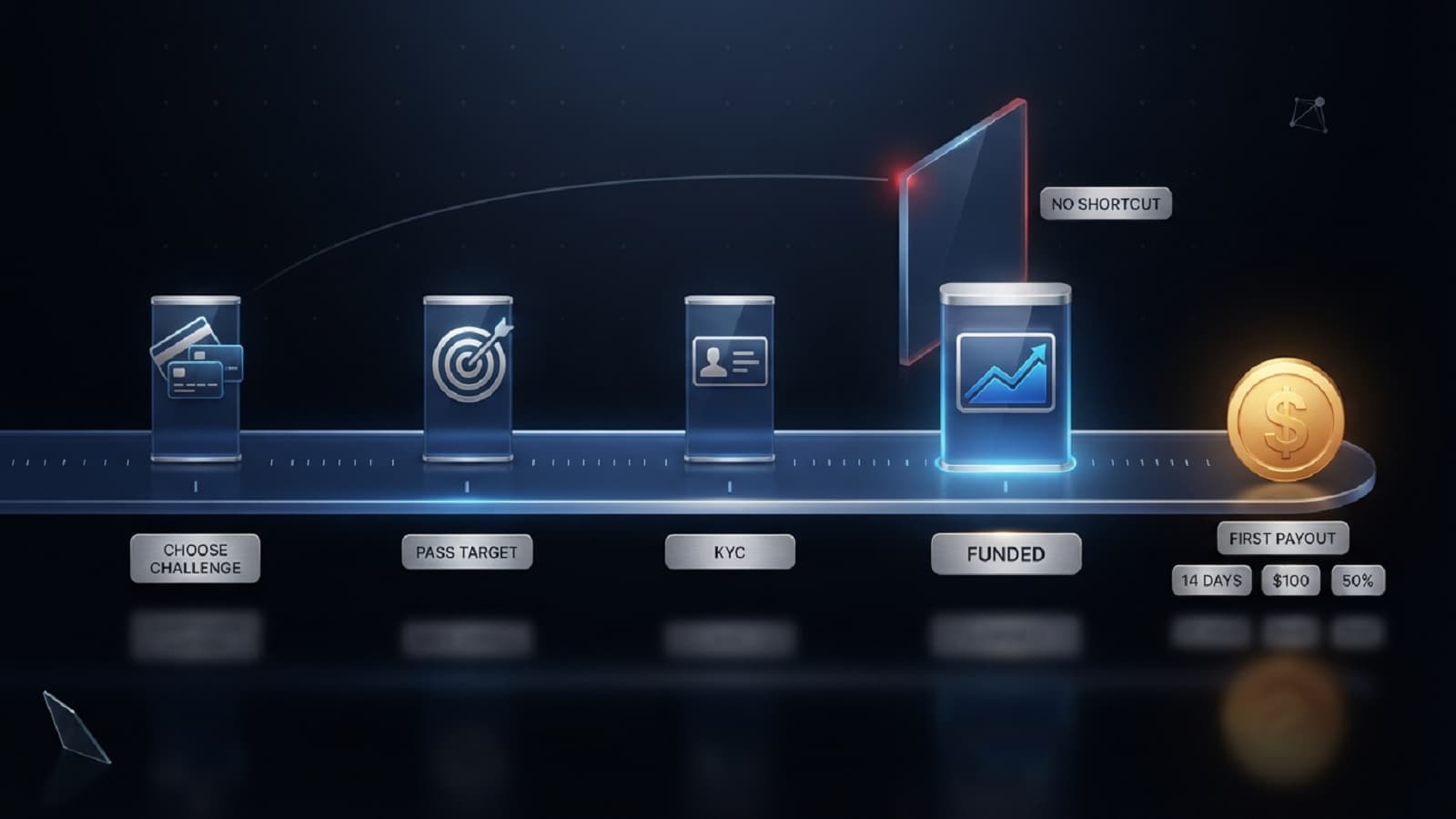
Administrative steps from purchase to a live funded account
Most guides pass over this part. Here is the order.
- You choose and buy the evaluation that matches your trading style and account size.
- Trading access is activated and you start trading on MetaTrader 5 (MT5).
- You reach the profit target inside the risk rules and pass the stage.
- On Standard and Rapid, the same thing repeats in Phase 2 with a lower profit target.
- Once you pass, identity verification takes place, and once it clears the funded account arrives within three business days.
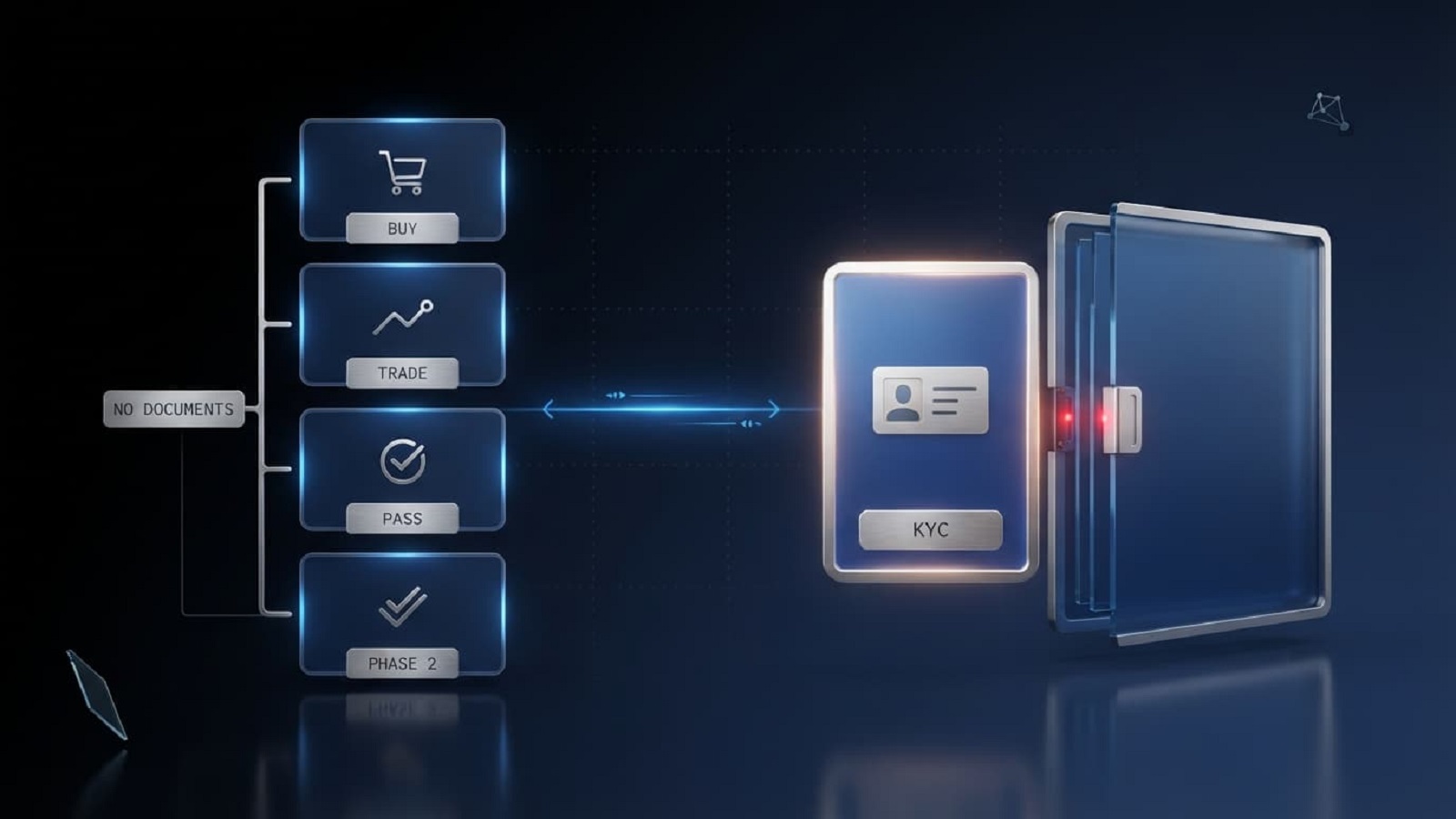
No document is requested from you before that final step.
The one decision to settle before your first trade
None of these steps runs against a deadline, and a gap between two stages costs you nothing. Only that first step is different.
Before you place any trade, you can ask to switch your challenge, for example between Standard and Rapid, which cost the same. Once trading starts, the choice stays, and a change of account size is not something to count on. Time spent on that first decision is worth more than speed on all the others. If you are torn between two evaluations, decide on trading style and not on the entry fee.
Identity verification happens only when you claim the account
Verification is not required before you buy an evaluation, and not partway through one. It happens at the moment you claim the funded account, and normally takes a few minutes.
That order gives you a practical advantage. You can start without dealing with documents, and nobody asks for identity documents until you have a result.
On the other side, arriving at the handover stage without being able to complete verification stops the route there. So if you have any doubt about your ability to verify, check at the very beginning, not after passing.
Account activation and the funded certificate
Once verification clears, the simulated funded account arrives within three business days, and you receive a funded certificate with a QR code on it.
From this point the risk rules are the same, but one new rule joins them that did not apply during the evaluation: the profit distribution rule, which plays a decisive part in when your first withdrawal happens.
Your first withdrawal after becoming funded
Three conditions have to hold together: 14 calendar days since your first trade on the funded account, at least $100 in accumulated profit, and the profit distribution rule satisfied. Each withdrawal must also be at least $50.
That third one catches most traders out. Under it, your best trading day may not account for more than half of your total accumulated profit. A single very strong day therefore does not bring the withdrawal forward, it pushes it back.
Each request is processed within 24 to 48 hours of submission, and the entry fee comes back in that same first withdrawal. From the second withdrawal onward you can withdraw every 7 calendar days, which in normal conditions means three or four withdrawals a month.
Your share of the profit is also settled at this stage. It is up to 90%, and accounts that grow through the scaling plan run at 90%.
Common mistakes on the route
Five mistakes repeat more than the rest, and all five are avoidable.
- Choosing the account size by the largest number available. An account closed on day five returns nothing, however large it was.
- Waiting for early verification. Some traders hold off trading until documents are approved, when that stage is not at the start of the route at all.
- Rushing to the profit target. None of the evaluations has a deadline, and speed earns you nothing.
- Ignoring the profit distribution rule. Trying to build the whole profit in one day is exactly what delays the first withdrawal.
- Ignoring trading costs. Commission and spread come out of gross profit, and leaving them out of the target calculation makes the distance longer than you expected.
A mistake that gets said less often
Many traders treat the route as finished once they are funded. In fact a second route starts at that exact point.
Account growth happens through the scaling plan on the basis of consistent performance, and not by buying a larger account. In 4 month cycles, at least 10% net profit (at least 2.5% per month) and at least one completed withdrawal add 25% of the initial balance to the account, up to a ceiling of $1 million. Being funded is where the second route starts.
Frequently asked questions
How do I become a funded trader?
Choose one of three evaluations, reach its profit target inside the risk rules, and complete identity verification once you pass. The simulated funded account is then issued within three business days, and your first withdrawal becomes available 14 calendar days after your first trade on it, once the other conditions are met.
Can I get a funded account without passing an evaluation?
No. Every trader passes an evaluation first and demonstrates their skill. You are never funded instantly and there is no route that skips the evaluation.
Which evaluation should I choose?
Whichever one matches your trading style. Standard is the only one that allows news trading, and only in Phase 1 and Phase 2 of its evaluation. Rapid has no minimum trading day requirement. Ace is single stage and the shortest route, with the strictest risk rules.
What account size should I take?
Take the volume you have been comfortable with on your own account. Risk rules are percentages, and a larger account is not harder in rule terms, but it puts more psychological weight on you.
What account sizes are available?
From $5,000 to $200,000. Anything larger is reached only through the scaling plan and is never sold directly.
Can I change the evaluation or account size after buying?
As long as you have not placed any trade on the account, you can ask to switch the challenge, for example between Standard and Rapid, which cost the same. A change of account size is not something to count on, so choose the size carefully before you buy.
How much does it cost?
Your entry fee depends on the account size and the evaluation you choose. For example, a $50,000 Standard evaluation is $329 at the site price, and the PASS20 code takes a further 20% off. The fee is refundable, returned with your first withdrawal.
What other costs are there?
Commission of $3 per lot, charged once per position, on forex pairs and metals only, plus the spread, which starts from 0.1 pip and varies by instrument. Both come out of gross profit, and you should build them into your profit target.
When does the entry fee not come back?
If you lose the account before your first withdrawal. In that case neither the accumulated profit nor the fee is paid to you. That refund is tied to completing the route and not to passing the evaluation.
When is identity verification required?
Only at the moment you claim the funded account, after passing. Never before purchase and never partway through an evaluation. It normally takes a few minutes.
What if I cannot complete verification?
Everything stops at the handover stage. If you have any doubt about your ability to verify, check at the very beginning, before you spend anything.
What happens right after I pass?
Verification takes place, the simulated funded account arrives within three business days of verification clearing, and you receive a funded certificate with a QR code on it.
What changes once I am funded?
The profit becomes withdrawable instead of acting as a score, and the account can grow through the scaling plan. One new rule also applies: the profit distribution rule.
What is the profit distribution rule?
Your best trading day may not account for more than 50% of your total accumulated profit. It applies on funded accounts only and is not assessed during an evaluation.
Why did a very profitable day delay my withdrawal?
Because it pushed your best day above half of your total profit. Keep trading and build profit across other days until the ratio falls below half.
When is my first withdrawal?
14 calendar days after your first trade on the funded account, with at least $100 in accumulated profit and the profit distribution rule satisfied. All three conditions have to hold together, and each withdrawal must be at least $50.
How fast are payouts?
Each request is processed within 24 to 48 hours of submission. From the second withdrawal onward you can withdraw every 7 calendar days. The guide to the prop firm payout route covers review stages and payment methods.
How much of the profit do I keep?
Up to 90%, and scaled-up accounts run at 90%. The breakdown of how much prop traders make works through what that turns into as a figure.
Is there a deadline on the evaluation?
No. None of the three runs against a clock, and a gap between stages costs you nothing. Two timing conditions remain: a minimum of 3 trading days on Standard and Ace, and at least one 0.01 lot trade in every 90 day period on every account.
What platform do I trade on?
MetaTrader 5. You get trading access as soon as you buy the evaluation.
Does becoming funded end the route?
No, a second route starts there. Account growth comes through the scaling plan: in each 4 month cycle, at least 10% net profit (at least 2.5% per month), plus at least one completed withdrawal, adds 25% of the initial balance, up to $1 million.
Am I trading real money?
No. Every account, evaluation and funded alike, is a demo account with fictitious funds and all trading takes place in a simulated environment. Only the profit you withdraw is real. NextGen Funding is backed by Errante, a broker operating under CySEC and the FSA Seychelles.
All accounts we provide to our clients are demo accounts with fictitious funds and any trading is in a simulated environment only.