Prop firm Malaysia guide to payments, swaps and payouts
A trader in Malaysia has something their neighbours do not: the ability to pay directly from a local bank account, with no international intermediary and no stack of currency conversions. That sounds like a small technical detail, and it is one of the things that decides the choice of a prop firm Malaysia traders can actually work with. Two checks matter before paying: whether a company appears on Malaysia’s official alert lists, and whether swap applies to your positions. Instead of listing names, this guide follows the money, from the moment it leaves your account to the moment it comes back larger. NextGen Funding, backed by Errante, is the worked example throughout.
How to identify the right prop firm for Malaysia
Through three checks, all of which happen before you pay. First, search the company name in two official Malaysian lists. Second, look at what accountable financial structure is behind the brand. Third, confirm the payment and withdrawal route works with your bank. General ranking lists do not cover any of the three.
Two official lists you can check in minutes
Bank Negara Malaysia maintains a Financial Consumer Alert list, naming companies and websites that do not hold its authorisation but have at times given the impression that they do. Bank Negara updates it periodically and publishes it on its own website.
Securities Commission Malaysia keeps a separate Investor Alert List. Search the company name in both before you pay anything. Suppose you find nothing: that clears one check, and no more. Ten minutes and no money, which makes it the best value check on the whole route.
Why absence from a list is not approval
Those two lists show only companies that have made incorrect claims or attracted complaints. Not appearing on them is not an endorsement.
An alert list only shows who has been flagged. It does not tell you whether a company’s model needs a Malaysian licence, and that is a question for the regulator or a local adviser. You pay a fee for a test, not a deposit to trade with. Your second criterion has to be the structure behind the brand. NextGen Funding is backed by Errante, a regulated broker holding licences from CySEC and the FSA Seychelles.
Paying from a Malaysian bank
The next stop is the moment money leaves your account. This is where conditions in Malaysia differ from most of the region.
FPX and DuitNow
Start with the payment rails. FPX and DuitNow are both supported. You can pay straight from your Malaysian bank account, with no international card in the middle. For example, a $25,000 Standard evaluation costs $179 at the site price, before the PASS20 code takes a further 20% off. Through FPX you pay the ringgit amount straight from your own bank, and no card issuer adds a foreign transaction fee on top.
Do not underrate that. Several markets in the region have no local rail on NextGen Funding, and traders there pay by card, bank transfer or digital currency instead. A shorter payment route means fewer points where a transaction can be declined, and more clarity about the real cost you are paying.
When the local rail is not available
If you prefer another route in, Visa and Mastercard, Apple Pay and Google Pay, bank transfer, USDC, and USDT on the TRC20, BEP20 and ERC20 networks are all available.
That list changes over time, and you should check the current version in the dashboard before paying. One thing worth knowing is that the route in and the route out are not necessarily the same, and you should look at both from the start. Payouts go out by Visa or Mastercard, by bank transfer, by cryptocurrency such as USDT, or through popular local payment methods across Southeast Asia, and the dashboard’s Withdrawal tab shows which of these are open to you.
What comes out of gross profit while you trade
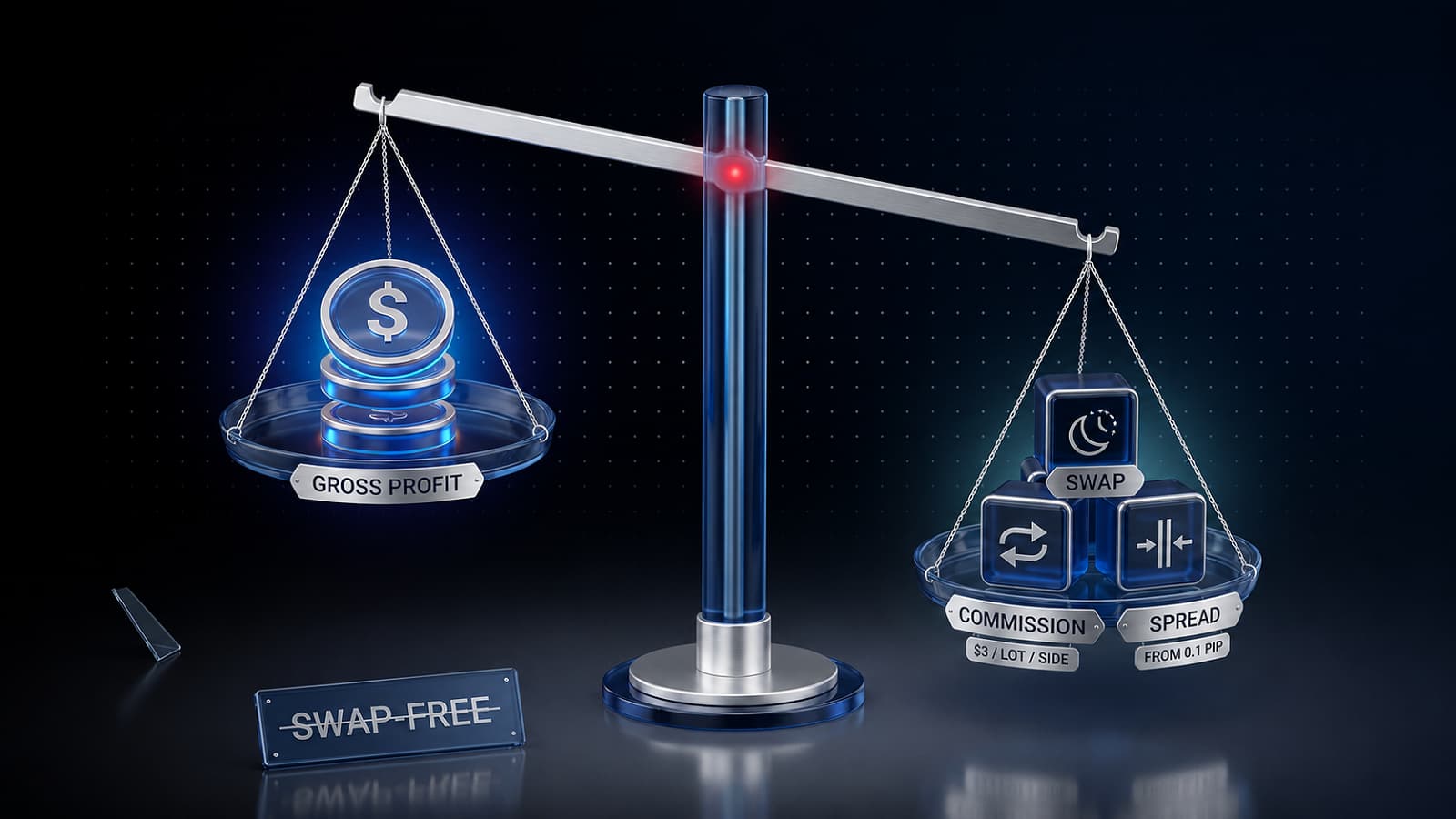
The money is in. During trading, several costs come out of gross profit, and not knowing them in advance is what breaks your calculations.
Swap and the swap-free label in the Malaysian market
You can hold overnight and over the weekend. Swap applies to every instrument in exchange. No category is exempt, and any trade that crosses the daily rollover has a holding cost.
On Islamic accounts it is better to be direct. NextGen Funding does not list a swap-free or Islamic account, and swaps apply to positions held overnight and over the weekend, in every evaluation and on funded accounts. If you would rather avoid the cost entirely, the practical route is keeping the strategy intraday and closing positions before rollover.
Commission and spread
Commission is $3 per lot, charged once per position, and it applies only to forex pairs and metals, with no commission on any other instrument. For example, a 1 lot trade on EUR/USD costs $3 in commission, not $6, and 10 lots across a week cost $30.
Spreads start from 0.1 pip and vary by instrument, and you should treat 0.1 as the floor and not a fixed figure. Check the spread on each instrument before opening a position on your MT5 prop firm terminal and build it into your stop loss and profit target.
Where the route can stop
Two risk rules end the route. Breach either one and it stops there. Knowing them precisely matters more than any other criterion here.
Two limits that close an account
Maximum drawdown comes from the initial account balance and stays fixed, and it does not follow you upward as profit grows. Your daily loss limit changes each day and takes the previous day’s closing balance as its base.
Know one detail precisely. Both levels are calculated from the balance, but what triggers them is your account equity. A floating loss on an open position counts, and the system does not wait for the trade to close.
Trading hours and the Monday gap in MYT
Your trading day turns over at 5 PM Eastern time, which is 5 AM MYT while the US is on summer time, from March to November, and 6 AM MYT for the rest of the year. Malaysia does not change its clocks, so the shift comes entirely from the US side. Traders across the border run on the same clock, covered in our prop firm Singapore guide.
This matters most at the end of the week. A position left open into the close can meet a price gap at the Monday reopen, and that gap alone can take out your stop. Review your open volume before the weekend break.
From recorded profit back to your bank
Recorded profit is not income yet. One stop remains, which is turning it into money you can withdraw.
Conditions for the first withdrawal
A first withdrawal from a simulated funded account needs three conditions together: 14 calendar days since your first trade on the funded account, at least $100 in accumulated profit, and the profit distribution rule satisfied, which stops one strong day from making up more than half of your total profit. Each withdrawal must also be at least $50.
From the second withdrawal onward you can withdraw every 7 calendar days, which in normal conditions means three or four withdrawals a month. Each request is processed within 24 to 48 hours of submission. Your share of the profit is up to 90%.
The entry fee refund
Whatever you paid at the start of the route is not written off. It comes back with your first withdrawal.
One condition attaches to it. If you lose the account before the first withdrawal, neither the accumulated profit nor the entry fee is paid to you. In your opening calculation, count it as money coming back only once the first withdrawal has gone through.
Which evaluation suits a Malaysian trader
Follow your trading style, not the shortest route. If part of your strategy rides economic data, Standard is the only evaluation that allows trading during high impact news, and only in Phase 1 and Phase 2. If you would rather not be tied to a minimum trading day requirement, Rapid is your answer. Three versions of the prop firm challenge are available: Standard and Rapid are each a 2-step challenge, and Ace is a 1-step challenge.
| Criterion | Standard | Rapid | Ace |
|---|---|---|---|
| Stages | 2 | 2 | 1 |
| Profit target | 10% and 5% | 8% and 5% | 10% |
| Maximum drawdown | 10% | 8% | 6% |
| Daily loss limit | 5% | 5% | 3% |
| Minimum trading days | 3 | 0 | 3 |
| News trading | Allowed in Phase 1 and Phase 2 | Not allowed | Not allowed |
News trading is not allowed on any funded account either, including one reached by passing Standard. On Rapid, on Ace and on every funded account, no trade can open or close from two minutes before to two minutes after a high impact release, and that includes a stop loss or take profit being triggered.
Where the route gets bigger
You have now walked the route once. From here it repeats with larger numbers, and this is the only way the account size rises without taking more risk.
Conditions for clearing each cycle
This runs through the scaling plan, on 4 month cycles. To clear a cycle, you need at least 10% net profit (at least 2.5% per month) for that period, and at least one completed withdrawal recorded alongside it.
With both in place, the account grows by 25% of the initial balance. Accounts scaled up this way run at a 90% profit split.
Why this growth does not compound
Calculations always run off the initial balance, which keeps the step the same size. An account chosen from the $5,000 to $200,000 range moves forward by that fixed step up to a ceiling of $1 million, instead of at a rate recalculated on each new figure. Take a $50,000 account: one cycle makes it $62,500, the next $75,000, and each later step adds the same $12,500.
Over a long horizon the difference between those two is large, and it is worth having an accurate expectation from the start. Choose your initial account size on the volume you actually manage, since that figure becomes the basis of your entire growth path.
Frequently asked questions
Can I use a prop firm from Malaysia?
Yes. Malaysia is one of the markets NextGen Funding serves, and both local payment rails, FPX and DuitNow, are supported.
Does a Malaysian licence apply to evaluation firms?
No general answer is safe, because it depends on the model and on current Malaysian rules. Evaluation firms take no client deposit and do not connect you to the market, and the wider question of whether prop firms are regulated is worth reading in full. What you can check instead is the structure behind the brand.
Which official lists should I check before paying?
Bank Negara Malaysia’s Financial Consumer Alert list and the Securities Commission Malaysia Investor Alert List. Searching the company name in both takes a few minutes.
If a company is not on those lists, does that mean it is approved?
No. Those lists show companies that have made incorrect claims or attracted complaints. Absence from them is not an endorsement, which means a clean search proves nothing on its own.
What is behind NextGen Funding?
Errante, a regulated broker holding licences from CySEC and the FSA Seychelles. That backing does not replace a local authorisation, and it does not make the evaluation business a licensed broker.
Can I pay with FPX or DuitNow?
Yes. Both are supported, and you can pay straight from a Malaysian bank account with no international card in the middle.
What other payment methods are available?
Visa and Mastercard, Apple Pay and Google Pay, bank transfer, USDC, and USDT on the TRC20, BEP20 and ERC20 networks. That list changes over time, and you should check the current version in the dashboard.
Is the payment route the same as the withdrawal route?
Not necessarily. Check both from the start instead of assuming the method you paid with is the one you will withdraw to. Payouts go out by Visa or Mastercard, by bank transfer, by cryptocurrency such as USDT, or through popular local payment methods across Southeast Asia, and the dashboard’s Withdrawal tab shows which of these are open to you.
Is there an Islamic or swap-free account?
NextGen Funding lists no swap-free or Islamic account. Swaps apply to positions held overnight and over the weekend, in every evaluation and on funded accounts, so closing positions before rollover avoids the charge.
How do I avoid swap costs then?
Keep the strategy intraday and close positions before the daily rollover and swap never enters the calculation. If your strategy is multi day by nature, build the holding cost into your profit target.
Can I hold trades overnight and over the weekend?
Yes, with no restriction. Swap applies in exchange, on every instrument.
What is the commission?
$3 per lot, charged once per position, so one lot costs $3. It applies to forex pairs and metals only, with no commission on any other instrument.
What are the spreads?
From 0.1 pip, varying by instrument. Treat 0.1 as the floor and not a fixed figure and check each instrument before opening a position.
How is the maximum drawdown calculated?
From the initial account balance, and it stays fixed instead of following your profit upward. Daily loss limits are set each day from the previous day’s closing balance.
Does a floating loss count toward those limits?
Yes. Your account equity triggers both, and an open position in loss counts and the system does not wait for the trade to close.
When does the trading day reset in MYT?
At 5 PM Eastern time, which is 5 AM MYT while the US is on summer time and 6 AM MYT for the rest of the year. From that point the daily loss limit is set again from the previous day’s closing balance.
What should I do about the Monday gap?
A position left open into the weekly close can meet a price gap at the Monday reopen, and that gap alone can take out your stop. Review your open volume before the weekend break.
What are the conditions for the first withdrawal?
Three, all together: 14 calendar days since your first trade on the funded account, at least $100 in accumulated profit, and the profit distribution rule satisfied. Each withdrawal must also be at least $50.
How fast are payouts?
After the first one, you can withdraw every 7 calendar days, and each request is processed within 24 to 48 hours of submission. The full prop firm payout route is set out separately.
Is the entry fee returned?
Yes, with your first withdrawal. If the account is lost before that point, neither the accumulated profit nor the fee is paid out.
What is the profit split?
It is up to 90%, and accounts that grow under the scaling plan run at 90%.
Does the account growth compound?
No. Increases are always calculated from the initial balance, which keeps the step the same size, up to a ceiling of $1 million. Sizes above $200,000 are reached only this way and are never sold directly.
Am I trading real money?
No. Every account, evaluation and funded alike, is a demo account with fictitious funds and all trading takes place in a simulated environment. Only the profit you withdraw is real.
All accounts we provide to our clients are demo accounts with fictitious funds and any trading is in a simulated environment only.