Prop firm Indonesia guide to reset times, swaps and payouts
It is two in the morning in Jakarta. Your evening session cost $400 on a $10,000 Standard account, but the calendar has turned, so you open a new trade with what feels like a fresh $500 daily allowance. A $150 loss later, the account closes with a daily loss limit breach. Nothing unusual happened in the market. Your trading day had simply not ended yet, because it turns over at four or five in the morning WIB. Midnight changes nothing. Traders choosing a prop firm in Indonesia learn rules like this one late, purely because of where they are on the map. This guide works through each of them, starting with the question that comes before any technical criterion. NextGen Funding, backed by Errante, is the worked example throughout.
Is using a prop firm legal in Indonesia
Traders in Indonesia can and do use international evaluation firms, and Indonesia is one of the markets NextGen Funding serves. A more useful question is which framework the model belongs to, because that is what decides how you should judge a company.
Local rules and companies outside their scope
Local rules on forex and futures are written for brokers that hold client deposits and connect clients to the market. Before paying any company, check the official register of the Indonesian regulator for the product you trade.
An evaluation model does neither. You pay a fee for a test and trade an account holding fictitious funds, and no deposit exists for that framework to protect. If a company claims authorisation from bodies unrelated to its actual activity, treat that as a warning sign on its own. Regulatory treatment of this model is still developing in many countries, and you should confirm your own position instead of relying on a general statement.
What to weigh when there is no local licence
That criterion changes, and it does not disappear. Instead of asking whether a local licence exists, look at what structure is behind the company and who is accountable.
NextGen Funding is backed by Errante, a regulated broker holding licences from CySEC and the FSA Seychelles. That backing does not replace a local licence, and Errante’s licences do not extend to the evaluation business.
A four in the morning trap
Back to that opening scene. This is the most practical part of the guide, and more accounts are lost in this gap than anywhere else.
Why your trading day is not your calendar day
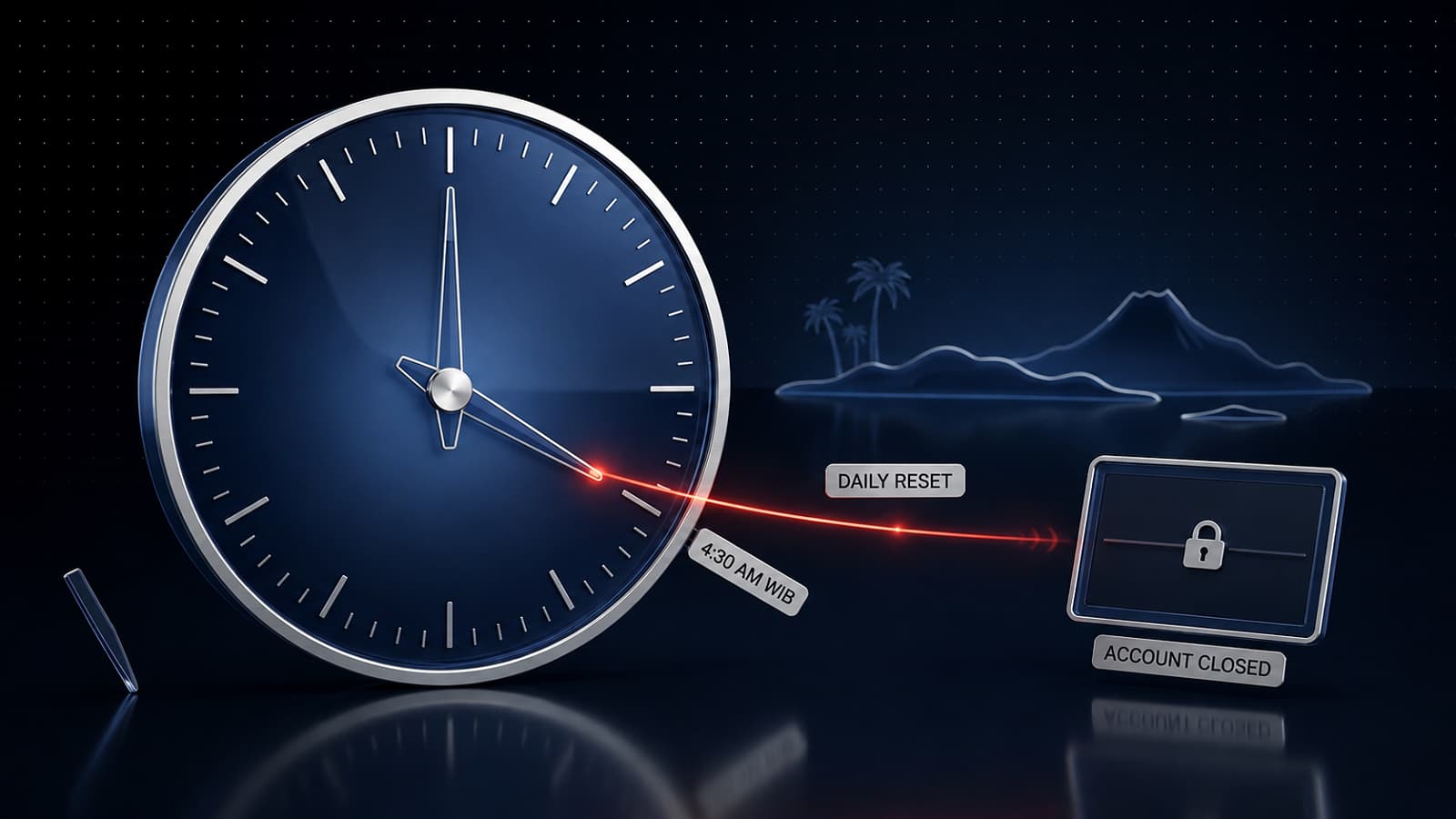
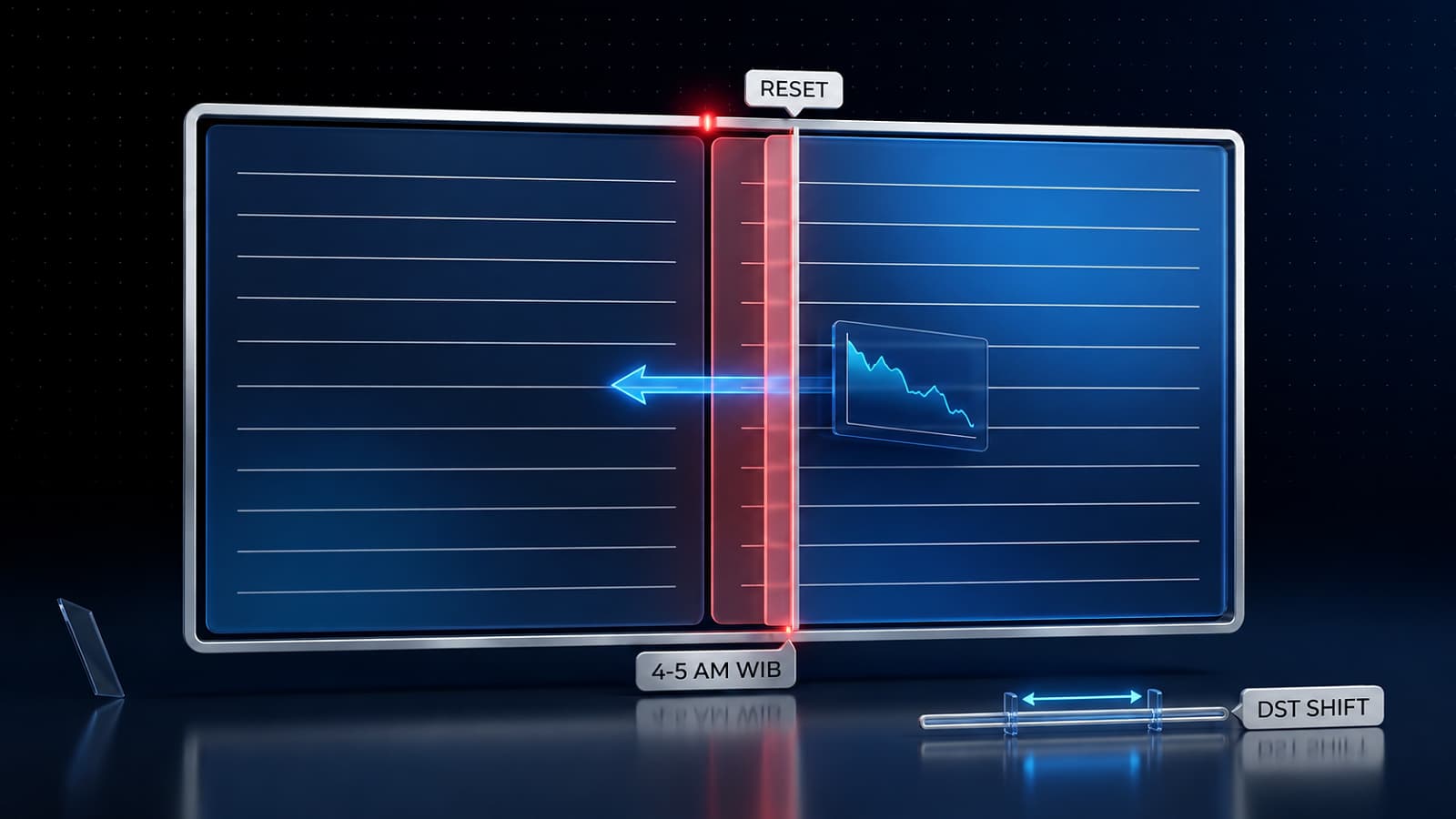
Your trading day on a simulated funded account turns over at 5 PM Eastern time. From that moment the daily loss limit is set again from the previous day’s closing balance.
Because WIB runs seven hours ahead of universal time, that point falls at four or five in the morning for you, hours after your calendar has changed day. Between midnight and the reset you are still trading the previous day, with whatever allowance the evening left. In the opening scene, $400 plus $150 comes to $550, which is past the $500 daily limit, 5% of a $10,000 Standard account.
A position still open at the reset also brings its floating loss into the new day, because the new limit is set from the closing balance while the check runs on equity.
That hour shifts twice a year
When US clocks change for summer time, that point moves an hour forward or back without anything changing in your own settings.
Calculate both cases once and keep the note somewhere. For example, the reset comes at 4 AM WIB while the US is on summer time, from March to November, and at 5 AM WIB for the rest of the year, so a trade you open at 4:30 AM lands in a different trading day depending on the month. In the hour before that point, control your open volume. That single habit removes a large share of unintended breaches.
A night when a trade stays open
Second on the list, and it matters more here than elsewhere, is the cost of holding a position overnight. For a large share of traders here it is not just a number, it is a choice about style.
Which instruments swap applies to
You can hold a position overnight or over the weekend with no restriction. In exchange, swap applies to every instrument, whether it is a currency pair, a metal, an index or a digital asset.
Any trade that crosses the daily rollover therefore has a holding cost. No category is exempt, and this should be clear to you before you buy an evaluation instead of partway through one.
If you want to avoid that cost
Keep the strategy intraday. Close the position before rollover and swap never enters the calculation. Say you hold 2 lots of gold for 4 nights. That is 4 separate swap charges before you have taken a single pip, which means your entry has to cover them before it covers anything else.
That decision shapes your whole trading style, and it is better made before you choose an evaluation. If your strategy is multi day by nature, build the holding cost into your profit target from the beginning.
Which evaluation fits the Asian market rhythm
The Asian session runs through your morning and midday, and it usually brings less movement. London opens at 2 or 3 PM WIB, depending on the season, and volume rises from there. The London and New York overlap then runs through your evening, which makes the afternoon and evening your most active stretch.
| Criterion | Standard | Rapid | Ace |
|---|---|---|---|
| Stages | 2 | 2 | 1 |
| Profit target | 10% and 5% | 8% and 5% | 10% |
| Maximum drawdown | 10% | 8% | 6% |
| Daily loss limit | 5% | 5% | 3% |
| Minimum trading days | 3 | 0 | 3 |
| News trading | Allowed in Phase 1 and Phase 2 | Not allowed | Not allowed |
If dollar data is part of your strategy
Only Standard allows trading during high impact news, and only in Phase 1 and Phase 2 of the evaluation. On Rapid, on Ace and on every funded account, including one reached through Standard, no trade can open or close from two minutes before to two minutes after a high impact release, and that includes a stop loss or take profit being triggered.
If you would rather work without a minimum trading day requirement, Rapid is your answer. Choose a prop firm challenge on your style first and on the shortest route second.
Once the profit is made, how it reaches you
This criterion usually gets checked last, when in fact a payment route that does not work for you leaves every other advantage on paper.
Which payment methods work
Payouts go out by Visa or Mastercard, by bank transfer, by cryptocurrency, including USDT on the TRC20, BEP20 and ERC20 networks, or through popular local payment methods across Southeast Asia. For many traders here the digital currency route is more practical than an international transfer. That list gets updated over time, and you should check the current version in the dashboard before your first withdrawal.
Three conditions open the first withdrawal
Three conditions have to hold together: 14 calendar days since your first trade on the funded account, at least $100 in accumulated profit, and the profit distribution rule satisfied, which stops one strong day from making up more than half of your total profit. Each withdrawal must also be at least $50.
From the second withdrawal onward you can withdraw every 7 calendar days, which in normal conditions means three or four withdrawals a month. Each request is processed within 24 to 48 hours of submission, and the evaluation fee comes back with the first withdrawal.
What happens after you are funded
Reaching a funded account is not the end of the route. From there, the account grows through performance instead of through paying in more.
Your share of the profit is up to 90%, and accounts that grow in size run at 90%. The scaling plan defines that route in 4 month cycles.
Growth conditions and the ceiling
The conditions are at least 10% net profit (at least 2.5% per month) across a cycle, plus at least one completed withdrawal. With both in place, 25% of the initial balance is added to the account.
Each step stays the same size and never compounds. For example, a $100,000 account moves to $125,000 and then $150,000. An account chosen at the start from the $5,000 to $200,000 range grows by that fixed step up to a ceiling of $1 million. Sizes above $200,000 come only this way, and nobody sells them directly.
Platform and timing
Everything runs on MetaTrader 5 (MT5) and none of the evaluations has a deadline. Two timing conditions remain: a minimum of 3 trading days on Standard and Ace, and at least one 0.01 lot trade in every 90 day period on every account, or the account becomes inactive and the fee, accumulated profit and pending withdrawals are forfeited.
Frequently asked questions
Can traders in Indonesia use a prop firm?
Yes. Indonesia is one of the markets NextGen Funding serves. You buy an evaluation, pass it and complete identity verification, and once verification clears the simulated funded account is issued within three business days.
Do Indonesian regulators license prop firms?
Local frameworks are written for companies that hold client deposits and connect clients to the market, and an evaluation firm does neither. Regulatory treatment of this model is still developing in many countries, so confirm your own position instead of relying on a general statement.
What should I check if there is no local licence?
What is behind the company. NextGen Funding is backed by Errante, a regulated broker holding licences from CySEC and the FSA Seychelles. The evaluation business itself holds no broker licence. The wider set of signals that separate legit prop firms from the rest applies here too.
When does my trading day reset in WIB?
At 5 PM Eastern time, which is 4 AM WIB while the US is on summer time and 5 AM WIB for the rest of the year. From that point the daily loss limit is set again from the previous day’s closing balance.
Why does that hour move twice a year?
Because the reset is fixed to Eastern time, not to yours. When US clocks change for summer time, the point shifts an hour forward or back without anything changing in your settings.
Why did my account breach the daily limit after midnight?
Most often because the trading day had not turned over yet. Until 4 or 5 AM WIB you are still on the previous day’s allowance, so losses after midnight add to the evening’s. Write down the reset time for both US summer and winter clocks, and control your open volume in the hour before it.
Can I hold a position overnight or over the weekend?
Yes, with no restriction. Swap applies in exchange.
Which instruments does swap apply to?
All of them. Currency pairs, metals, indices and digital assets all take swap. No category is exempt, and any trade that crosses the daily rollover has a holding cost.
How do I avoid swap altogether?
Keep the strategy intraday and close positions before rollover, so swap never enters the calculation. If your strategy is multi day by nature, build the holding cost into your profit target from the start.
Which hours of my day are most active?
Afternoon and evening WIB. London opens at 2 or 3 PM WIB, and the London and New York overlap runs through your evening. The Asian session, which covers your morning and midday, usually brings less movement.
Which evaluation suits me if I trade dollar data?
Standard, a 2-step challenge, is the only one that allows trading during high impact news, and only in Phase 1 and Phase 2 of its evaluation. On Rapid, on Ace, which is a 1-step challenge, and on every funded account, that trading is not allowed.
Which evaluation has no minimum trading days?
Rapid. Standard and Ace each require a minimum of 3 trading days.
Can I trade the news once I am funded?
No. News trading is not allowed on any funded account, including one reached by passing Standard.
How can I withdraw my profit from Indonesia?
By Visa or Mastercard, by bank transfer, by cryptocurrency, including USDT on the TRC20, BEP20 and ERC20 networks, or through popular local payment methods across Southeast Asia. That list gets updated over time, and you should check the current version in the dashboard.
What are the conditions for the first withdrawal?
Three, all together: 14 calendar days since your first trade on the funded account, at least $100 in accumulated profit, and the profit distribution rule satisfied. Each withdrawal must also be at least $50.
What is the profit distribution rule?
No single trading day may make up more than 50% of your total accumulated profit. If your best day passes that share, you keep trading until the ratio falls back below half. It applies on funded accounts only.
How fast are payouts?
After the first one, you can withdraw every 7 calendar days, and each request is processed within 24 to 48 hours of submission. The full prop firm payout route is set out separately.
Is the evaluation fee returned?
Yes, with your first withdrawal. If the account is lost before that point, neither the accumulated profit nor the fee is paid out.
What is the profit split?
It is up to 90%, and scaled-up accounts run at 90%.
How does the account grow?
Through the scaling plan. In each 4 month cycle, at least 10% net profit (at least 2.5% per month), plus at least one completed withdrawal, adds 25% of the initial balance, up to a ceiling of $1 million. Each step stays the same size and never compounds.
Is there a deadline on the evaluation?
No. Two timing conditions remain: a minimum of 3 trading days on Standard and Ace, and at least one 0.01 lot trade in every 90 day period on every account, or the account becomes inactive and the fee, accumulated profit and pending withdrawals are forfeited.
Am I trading real money?
No. Every account, evaluation and funded alike, is a demo account with fictitious funds and all trading takes place in a simulated environment. Only the profit you withdraw is real.
Can I get a funded account without passing an evaluation?
No. Every trader passes an evaluation first. You are never funded instantly.
All accounts we provide to our clients are demo accounts with fictitious funds and any trading is in a simulated environment only.